Search This Blog

Wednesday, January 29, 2014

Sustainability: Stone slabs industry dust utilisation


Towards a sustainable future

Background of the case:

I  had earlier worked on developing a useful product viz: Pavement Blocks from industrial waste i.e. cupola furnace slag. While sharing the case study with a group, one of the participants, Mr. Aakash Mittal, approached me and expressed that his family industry was also facing a similar problem and whether I can help his family business and find a solution similar to the cupola slag.
As there is never ever a single cut out solution for such wastes, I desired to visit the industry and offered to give it a shot, but didn't promise a solution off hand.
Accordingly, a visit was planned for the unit located in Gwalior, Madhya Pradesh. It turned out that it was a stone slabs manufacturing unit.

Gwalior stone slabs industry:

Gwalior region in MP, like many other geographic regions, has a cluster of stone slabs manufacturing units. The cluster has about 60 units within a radius of about 50 kms. encompassing the small towns of Banmore, Purani Chawni, Morena, Dhaulpur etc.
The stone slabs have found their utility in large scale construction activity. The process involves quarrying large stone blocks (Picture-1), Slicing the slabs on a endless blade cutting machine (Picture-2 and Picture-3), and finally sizing them as per specifications and offerings (Picture-4). The finished slabs are also graded based on the quality of the stone and geological structure.


                   Picture - 1                                        Picture - 2

                                           Picture - 3                                 Picture - 4                     

   Picture-5

The problem definition:

While everything seemed to be going smooth for the industry at large, during a detailed chat with the owner of the unit (Picture-5) , the owner of the unit expressed that they in fact have a serious problem with the disposal of the stone dust, which is a by product of the process of cutting stone blocks in to slabs. He also narrated his experiences with the neighbouring population’s resistance and the directives from the state Pollution control boards, threatening that the units may be asked to close down if they don’t find a permanent solution to the stone dust. He also informed Prof. Chari that in the previous year alone they had spent about Rs. 4,00,000 (Rs. Four Lacs) for clearing the space occupied by earlier dust. However, all they could do was just to shift the location of the heaps.
This prompted a visit to the area surrounding the unit. It revealed that the whole neighbourhood was strewn with fine greyish powder, all around the unit and spreading about 500 meters radius. Pictures 6 to Picture 9 show the condition of the area. where they have been dumping it over the past years.
                  Picture-6                                                Picture- 7

  
                        Picture-8                                              Picturee-9

However, the present process used for cutting stone slabs will always generate the dust.
During the discussions, it was estimated that on an average, an estimated about 4 to 5 truck loads (about 40 to 50 mts.) of such dust  is generated daily in the region.
With a view to find a solution to the problem, some samples of the dust were collected.

Experimentation:

Many initial and ground level experiments were conducted, but without any result.
At this stage, Prof. Chari decided to embarked on a scientific approach to the issue.  The dust samples were sent to laboratories for chemical analysis to find the basic composition.
The results receivd from the laboratory are produced here below.
L.O.I     
0.74 %
SiO2     
91.98 %
Al2O3   
2.78 %
Fe2O3  
0.80 %
CaO      
0.67 %
T.CO3   
Nil

From the above results, it was found that the dust contains about 92% Silica and the remaining comprise traces of Alumina, Iron Oxides, Cao and other ingredients.
Having come to know about the content of Silica, the Prof. Chari remembered his work in the past at Glass Industry in the town of Firozabad in Uttar Pradesh- India. He remembered that the glass industry also uses silica rich raw material for producing Glass.
He searched through his database and found out the contact details of a glass expert with 50 years of experience in glass industry. That was Mr. Shrivastav, General Manager of M/s Nannoomal Glass Industries in Firozabad.
Mr. Shrivastav was contacted and requested to give his impression about the practicality of using this material as a raw material for glass manufacturing.
Mr. Shrivastav desired that a sample be sent to him and he would get it analysed as per their own standards. Accordingly, on his advise, a sample was sent to the laboratory of the Center for Development of Glass Industry (CDGI), an extension of the CGCRI (Central Glass and Ceramic Research Institue, Calcutta, a central government organisation.
The results given by the laboratory were as below.

Analysis carried out by CDGI, Firozabad

Item No.
Element / Parameter
Percentage
1
LOI  (Loss On Ignition)
00.59
2
Sio2 
94.02
3
Al2O3 
02.59
4
Fe2O3 
00.12
5
Na2O 
00.32
6
K2O 
01.94
7
Cao 
00.27
8
Mgo 
NIL

 Sieve analysis of stone dust sample

 SAMPLE TAKEN 100 gms
 MESH NO.         
WEIGHT RETAINED ON SIEVE
Percentage
CUMULATIVE %
25                             
0.3                                                      
0.3                                                      
0.3
35                           
0.7                                                      
0.7                                                       
1.0
50                                                                            
40.0  
40.0  
41.0
90                          
52.0                                                    
52.0                                                     
93.0
100                          
4.0                                                    
4.0                                                    
97.0
-100                         
3.0                                                   
3.0                                                  
100.0

After reviewing the results, Mr. Shrivastav told that while the material can not be used for producing white glass, as it contains iron oxides more than the process can handle, however the material can be definitely used for making coloured glass.
At this stage, I initiated a dialogue with the Firozabad Glass Industry cluster and the responses from some of the manufacturers of glass bangles have been very encouraging. Mr. Gupta, Chairman of the Durga Glass Works, who had more than 60 years of experience with glass production, straightaway said that the material can be directly used as a raw material. He offered to produce a batch, subject to the condition that a sample of 500 Kgs. is delivered in his factory.
This effort proved that with some initial processing, the waste has a high potential for use as a basic raw material for glass bangles of the darker colours.

Other experiments:

While the above was underway, Prof. Chari continued with his experimentation to identify some alternate possible uses of the waste. Having come to know that the waste contains high percentage of silica, he remembered his association with energy experts who had told him that silica is indeed a very good material for heat insulation application. Taking a clue from this, many expetiments were carried out in the direction of identifying and exploring the possibility of use of the material as a heat insulation material.
Some experimental blocks were developed with various binding agents and the initial experiments had shown a very favourable result. It was felt that if it works that way, there indeed is a great opportunity for use of this material as Low Cost heat insulation blocks for use in lining of industrial furnaces.
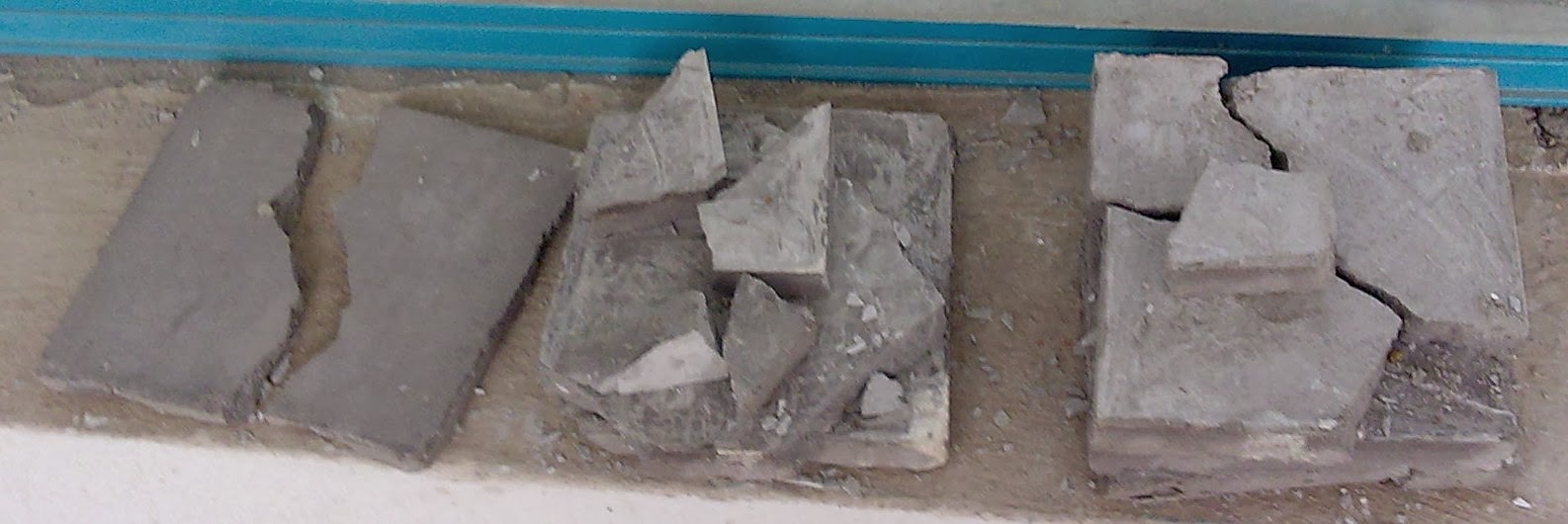
While failures were faced in some of the experiments (Picture- 10), the “Never Say Die” attitude finally brought out some very successful outcomes.
With one of the binding material, viz: Plaster of Paris (POP), the blocks were made successfully. Picture-11 and Picture- 12.

Picture 13                          Picture-14


Picture-15:  Two sides after 12 minutes (six minutes each)

Experiment for establishing the heat insulation properties of the blocks.

The initial experiments were carried out at home laboratory level. The pan with one of the above mentioned slabs was heated for 60 minutes to ensure that the whole set up is stabilised for the experiment. Two modules of dough were made from single lot and placed on the pan, Picture-13, and it was observed that the dough kept directly on the pan was burnt as shown in Picture-14, in just about 6 minutes, whereas nothing happened to the dough kept on the slab.
   
           
The burnt dough was turned upside down and after another 6 minutes was found to be burnt in the same way as the first side. Picture- 15. However, the dough kept on the slab was seemingly not much changed.

  Picture-16    Picture – 17: Condition after 85 minutes

The experiment was continued for a total of 60 minutes, but the dough on the pan did not burn at all. See Picture-16
                      
To doubly ensure the initial findings, one more fresh lump of dough was added and the heating was continued till 85 minutes. The condition of the dough blocks didn’t change much. Picture-17
This experiment showed that the material definitely has some heat insulation properties, as it does not allow the heat to pass through very easily.
This was followed by constructing a real life furnace with equal wall thickness brick furnace. Picture – 18. The top of the roof was covered with the blocks Picture-19 and the furnace was fired. Every thing, from construction of the furnace to laying the roof and plastering, was seeming to be a great success. The felt temperatures on the side walls and roof were definitely much different, and the roof was found to be much cooler than the side walls.


                                      Picture 18                                         Picture-19
However, after about one hour, the roof collapsed. Picture -20 and 21.


                        Picture-20                                                        Picture-21
While an average person would get disheartened with such happenings, but the experimenting team always believed that every failure and disappointment is a step towards further research.
Based on these observations, Prof. Chari requested M/s Durga Glass Works at Firozabad to allow his team to undertake a real life and live experimentation on one of their Talli Bhattis, with these slabs.
M/s Durga Glass Works of Firozabad have already given us a clean chit and welcomed to carry out any experiment that we may want to, and agreed to allow experiments on one of their live furnaces.
A team of students comprising Mr. Aakash Mittal was sent to the unit with these blocks and they conducted the experiment by directly placing the blocks on the furnace (Talli Bhatti)
It turned out to be a highly successful experiment with highly favourably results.
We arranged tiles made of waste on Furnace at 07:30AM. A time of 2 and half hours was allowed to get a stabilised state of the furnace surface. The readings were taken at 10.00AM (After two and half an hour).
At one place on the conventional surface of the temperature of furnace was measured to be 2800C while the temperature on the experimental blocks was only 1500C.
At another place, the corresponding temperatures were observed to be 1900C and 1200C respectively.
The observations continued and at 11.00 PM ( after three and half hours) while the surface temperature on the conventional surface was observed to be 3500C, the temperatures on the slabs were observed to be only 1500C, which clearly indicated that the about half inch thick slabs can help dropping the surface temperatures by almost 2000C, which will help in drastically reducing the furnace surface radiation losses, and thereby enhance the thermal efficiencies of the furnaces. This has it’s own advantage by reducing the carbon foot print of the industry.
The pictures 22 through 25 show how the experiment was carried out.

                     Picture-22                                      Picture-23


                                                                               Picture-24  


            Picture-25
Interaction with CGCRI Khurja also carried out an analysis of the material and expressed their impression that the material perhaps can be used for Glazing of ceramic pottery, and have offered to carry our some experiments.
A similar discussion with some of the iron and steel foundries revealed that silica rich (94%) material can also perhaps be a candidate for either foundry sand or facing sand too.
The future work involves extensive experimentation, scientific testing and proving of the product. The future work will also involve Finding different ingredients for blending, increasing  the mechanical strength  of the bricks,  Thermal Conductivity testing etc. The making of such products needs an infrastructure, organization, laboratories, and live testing of the products in industry.

Wednesday, June 2, 2010

Annual Reports of companies and their carbon foot prints.

Annual Reports of companies and its Carbon Foot Print:
A Corporate Social Responsibility Issue:
Genesis:
There are about 7,000 listed companies in India, who are governed by the rule of having to publish their annual reports and circulate them to the share holders.
Out of these, the NIFTY and the SENSEX themselves cover a total of 80 companies (Sensex 30 and NIFTY 50) with about 1,50 Million individual share holders. As per the statute, each one of them is supposed to be sent the annual reports of these companies. Of the about 6,920 companies, the average share holders nos. are about 10,000 per company.
This gives a total figure of about 220 Million individual share holders, each one of whom receives a copy of the annual report of their company. It is a fair estimate that almost about more than 70% of the share holders are in three states alone, viz: Gujrat, Maharashtra and Rajasthan, majority of whom can not read a balance sheet and understand the nuances of the annual report.
The environmental impact:
Considering an average weight of say 100 gms. of paper per annual report, this gives a whopping figure of about 2,200 MT of annual paper used for this purpose.
The associated details with this figure are;
a- @ an average of 1,100 Kwh of electricity used per MT of paper production, this results in to an annual electricity consumption of about 24,200 Mwh of electricity, which in turn means about 30,000 MT of CO2 emission (@ about 1.3 MT CO2 per MwH) in to the atmosphere, annually, in addition to depriving some more needy users.
b- The timber resources used to make wood pulp are referred to as pulpwood. Wood pulp comes from softwood trees such as spruce, pine, fir, larch and hemlock, and hardwoods such as eucalyptus, aspen and birch.
Land marks: Ecological footprint (hectare)
Fibre requirements of the pulp and paper sector are met by bamboo, hard wood, agrowaste and wastepaper. The amount of land required by a mill to meet its raw material needs equals the ecological burden that the mills’ fibre sourcing has on the environment.
Company Land needed by mills to produce one tonne of paper
BILT-Ballarpur Unit 4.85
The West Coast Paper Mills Ltd 1.3
Indian average 2.17
The average Indian mill's footprint is 2.17 hectares (ha) for every tonne of paper it produces. Taking the total annual production of paper to be around 3.2 million tonnes, the total land requirement of the Indian pulp and paper sector would be 6.4 million ha. India has over 60 million ha under forest land and more available under private wasteland.
It is the combined responsibility of all the stake holders, viz: The investors (whose money is being spent for the purpose, which otherwise could have been reported as net profit of the company). The Government, which can save about 48,000 hectares (@ an average of 2.17 hectare per MT of paper) of forests every year from deforestation (and its resultant effects on environment).
Impact on water resources:
Needless to say, water is becoming scarce day by day. And, paper industry is a major user of water for processing paper. A 1989 study conducted by the Bureau of Industrial Costs and Prices showed that the pulp and paper mills in India consumed around 805 million cubic metres (cum) of water to produce 2.7 million tonnes of paper — on an average around 300 cum per tonne of paper produced. They also reported that the water demand was not similar in all the mills and drastically varied between 130 cum to 450 cum per tonnes of paper produced, with about 80 per cent of the units consuming less than 325 cum per tonne of paper and 47 per cent consuming less than 300 cum per tonne. In general, requirements for water is least in straw and paperboard mills (75-1,000 cum per tonne) and highest in specialty paper mills (370-1,220 cum per tonne). And mind it, the paper we use for the purposes of the annual reports generally falls under this category of specialty paper.
Today, almost two decades later, the water consumption pattern has not changed much. According to the CSE study, on an average, large-scale Indian mills still consume about 250-350 cum of water per tonne of paper produced. Water consumption patterns and effluent discharges of Indian mills still vary substantially from mill to mill, even when the same process and equipment is used, which should not be the case. In contrast to the Indian scenario, the average water consumption in US mills has come down from 142 cum per tonne of paper produced in 1989 to 72 cum in 1995. The poor showing of the Indian mills can be blamed on the water-pricing policy of the government. Water literally comes dirt cheap to the mills so there is no attempt to regulate its use.
Based on the above information, we can safely conclude that by avoiding the annual reports printing, the government could help the nation by avoiding the use of about 9 billion litres of scarce water annually (@ 400 cubic meters per MT of paper). In terms of usage, this would mean total annual water requirement of about 2,45,000 persons annually (@ 100 litres per person per day).

Shareholders Responsibility too:
Are the share holders not equally responsibility. If all those decide not to insist on getting a printed copy of the annual reports, this amount of money can be taken out of the expenses and would straight away be added to the net profits of the companies. Considering an average cost of printing, packing, forwarding, postage etc. at say Rs. 20 per copy (at the lowest), this would mean an addition of about Rs. 44 Billion added to the net profits of these companies.
The bonus point will be the immense mental and administrative relief to the companies , who would not be required to undertake this voluminous unproductive work.
What about the role of the various governmental bodies and ministries like the Company Law Board, Finance Ministry, SEBI etc. etc.
The foreign exchange angle:
During the FY 2008-09, India’s import of paper stood at Rs. 370,630 Lacs and by quantity we had imported and Rs. 792,178.11 lacs respectively in the category nos. 47 and 48
This gives us a total of Rs. 11,62,808 Lacs. And that is huge amount of money in foreign exchange, which we can ill afford.
Considering the portion of imported paper/pulp, which is normally the paper used for all the annual reports, it will be a great service to the Indian Economy if such a step is taken.
The imports of pulp and waste paper have registered a 14.04 per cent rise during the last fiscal. The value of the imports stood at $558.22 million in the fiscal 2005-06 compared with $489.51 million in the previous fiscal.
The imports of paperboard were on the rise as well witnessing a 39.55 per cent increase during the last fiscal to $982.03 million compared with $703.7 million in the corresponding period last year, according to Government data.
Analysts attribute the jump in imports to the rising cost of raw materials for writing and printing paper, duplex board and newsprint. While pulp, waste paper and paperboard have registered a significant rise in imports, the increase in newsprint imports has been around 10.08 per cent during the last fiscal.
According to Mr R.R. Vederah, Joint Managing Director, Ballarpur Industries Ltd (BILT) and President of the Indian Paper Manufacturers' Association: "The primary reason for the import of pulp and other intermediary products is because it is more cost-effective to do so." Analysts point out that the quantum of pulp imports is only going to increase in the future on the back of robust demand for paper in the country which is expected to grow in line with the GDP.
While companies such as BILT are resorting to acquisitions abroad to satisfy their raw material requirements, other paper firms such as Orient Paper and Industries Ltd (OPIL) are relying on local plantations to meet their needs. Mr M.L. Pachisia, Managing Director, OPIL, said: "We are not importing any pulp so far as we are able to meet our requirements though the local plantations."
Further, speculation is rife about the entry of two foreign newsprint companies into India, which are looking to set up a newsprint production unit in the country with the material sourced domestically. This, analysts observe, could lead to a fall in the quantity of newsprint imported.
The Business Line of the Business Daily from THE HINDU group of publications, dated Friday, Aug 21, 2009 (Ref: http://www.thehindubusinessline.com/2009/08/21/stories/2009082151340300.htm
Coated paper import into India has seen nearly a 70 per cent upswing during the first quarter of the current financial year. Industry observers note that the export incentives by China have helped firms from that country make inroads into India affecting the local industry even as the latter reiterated its demand for the creation of a robust raw material base.
“Against imports of 25,097 tonnes in the January-March quarter, the imports of coated paper went up to 42,971 tonnes in the April-June quarter. Almost 50 per cent of the import is from China. The import of coated paper from China went up from 13,345 tonnes in January-March to 19,165 tonnes in the April-June period,” the Indian Paper Manufacturers Association (IPMA) said.
According to Mr R. Narayan Moorthy, Secretary-General, IPMA, “In view of the global melt-down, the Asian paper market continues to remain vulnerable and major players from countries such as China and Indonesia are pushing large quantities of coated and uncoated wood-free grades of paper into the Indian paper market.”
He said that the cost, insurance, freight (CIF) price reigning at more than $800 a tonne in January is now at little more than $700 a tonne leading to a surge in imports. India is among the fastest growing paper markets in the world, despite the economic slowdown.
Printed matter worth Rs 3,500 crore in the form of books and journals is imported into the country at zero rates of duty affecting the paper industry as well as the 1.5 lakh small and medium printers.
The industry has reiterated its demand for the creation of a robust raw material base through implementation of the multi-stakeholders partnership model proposed by the Ministry of Environment and Forests.
The solution:
While we claim that we are implementing the e-governance, what stops us from incorporating a simple clause or a law that henceforth Annual Reports of the companies SHOULD NOT be printed but only made available to the users on an assured platform. And such an assured platform is none other than the web. In any case, this is already made available on the web sites under the existing law. The provision in the law can also incorporate a clause that if some one desires a printed hard copy of the annual report, the same would be made available at a cost. (This can be easily printed from the soft copy, even at a much higher cost). Once such a statute is put in place, no one can insist on getting hard copy.
The effected parties:
Of course, any such a harsh step would effect some quarters, viz:
1. The printers and publishers (for whom it may mean loss of opportunity and business)
2. The transporters: With an average of 10 MT per truck load, this accounts for usage of about 2,200 truck loads of transportation per year. These operators would loose this portion of the business. However, this also has its own share of carbon emission.
3. The packers and forwarders
However, the mute question is: Should we be really concerned about such loss of opportunity for a totally unproductive purpose, and at the cost of such an environmental impact. Should we also not be bothered about the environmental impact and should the government be not bothered about it’s own Corporate Social Responsibility?
Its time we ask a few soul searching questions, and put the much required statue in place for a productive purpose.

Tuesday, June 1, 2010

Share Market game

Dear Friends,
There is nothing wrong in one's own beleifs and feelings. So is with me.
For a long long time, almost 25 years, I have been debating with my colleagues about the share market.
Do we, I mean all those who spend time and play in the stock market, really know the dynamics of the whole issue.
After all, what are we up to?
When I buy a share or sell a share, excepting the BSE, who gains? Does any part of my transaction money find it's place in the accounts of the company I am dealing with?
NO.

Then, what are we really up to?
Do you see any sense in buying a share at an investment of Rs. 3,000 per share (, Remember, the face value of the share is only Rs. 10).
Even if the company declares a dividend of 100% (which is rare and impossible), all you will get is Rs. 10 per year, and that, on an investment of Rs. 3,000. Does it really make any sense?

Then the question is, What the hell are we doing?
Just playing amongst ourselves. To put it in simple terms, GAMBLING.

And in our foolishness, the only agency that makes the real money is BSE or the NIFTY or the broker companies, who are always the gainers, whether you loose or win.

Just think about it.

Saturday, April 3, 2010

Its Criminal to use electric geysers

It is criminal to use Electric Hot Water Geyser

When you use the electric geyser to heat water for your bath, Do you realise what you are contributing to the climate change through carbon emission:

Well, the 1 Kw water heater is the most common gadget in any house. And we proudly tell all the guests that we have geysers in all the bathrooms.

Did we realise what we are doing?

A 1 Kw heater consumes 1 Kwh or one unit of electricity in one hour.
This unit is available at our plug point after having consumed the about 30% transmission and distribution losses from the generating station.
This means, some one is generating 1.43 units somewhere else. ( for evey .7 Kw at the user end, another .3 Kw has to be generated, hence for 1 unit at user end, 1.43 units generated)It takes about 700 gms of coal to generate one unit of electricity.
So, for 1.43 units, some one is burning about 1000 gms of coal or one Kg. If we consider the ovrall efficiencies of the geysers, you could as well multiply the figures by almost 2.5 times.

This one Kg coal generates it's own part of the carbon di oxide.

Now look at the other way. 1 Kg coal contains about 4000 KCals of heat.

One more way of looking at this is to know that we burn coal to heat water, then make steam out of it, run a turbine through this steam, generate electricity, transmit it all the way, distribute it through the network, bring it to our plug point and then again use it to heat water.

Think seriously. Is it necessary for us to use electricity for heating water. Just try taking cold water bath. Its so soothing. And in turn, help environment, by contributing your own little bit.

I am doing it for more than twenty years. You can try it too.

After all, coal is not going to last for ever. A day will come when we will not have it at all.

Friday, April 2, 2010

My Social Responsibility project: Energy conservation and Renewable energy use at Dwarka Tirumala Temple town


This was sometime during the year 2003 when I happened to visit the temple town o Dwarka Tirumala, in West Godavari District of AP state. As I was to attend a marriage unction, I was lodged in one of the dharmashalas in the town.
In the early morning, when I got up and wanted to get ready for the marriage function. I could hear many voices out side my room, when every one was asking where and how to get hot water for taking bath. The host was finding it difficult to supply water to every one at the same time, as there was only one watchman in the dharmashala who used to help people with hot water. I was wondering as to why every one can't take bath with normal water like I have been doing for the past about 15 years.
Out of curiosity, I wanted to see how this man was heating water. There it was. The most conventional Indian way. Put water in a vessel on the chulha and feed wooden logs and fire them.
This immediately caught my attention and I started wondering as to how much fire wood might be burnt every year just for this one purpose. I started calculating the estimated consumption of fire wood per year and some back calculation as to how many trees might be used for the purpose. Further back calculation took me to the hectares of forests required to supply this wood and so on right up to the level of environmental impact, deforestation, carbon emission etc. etc.

It was a mind boggling figure that emerged. I started thinking about why not to do something about this subject. I asked myself as to what I can do about it and how I can do my own bit.

Incidentally, I was also a member of the Energy Conservation Mission (ECM) formed under the umbrella of the Institution of Engineers (India). I of course still continue to be the member. As a part of this institute, many of us like minded members had decided to devote some of our time for a good cause.

It was Captain Jalagam Rama Rao, honourary chairman of the ECM who initiated the process. He had a direct contact with the Chairman of the Temple trust, Mr. S. V. Sudhakar Rao, whose family is the patron of the temple too. Capt. Rao spoke to the chairman and fixed a meeting for me. This was one occasion when I happened to meet an open minded and forward looking person in the chairman of the temple trust.

In the first meeting, I shared my experience and observations during the previous trip. He immediately realised the larger impact of the situation. He himself was an environmentalist. I shared with him the idea as to why the temple town should not use the solar energy for this purpose. he readily agreed to implement it. My part of the job was very simple now. I identified one of the manufacturers of the solar water heating systems in hyderabad and asked him to the temple town and meet the authorities.
In the first instant, the temple got one of the 500 Litres per day capacity. Having seen the impact and the over all effect and advantge, the temple town has subsequently added more capacity in other dharmashalas and as of date, the temple town has a total of about 5,500 litres per day capacity.

I still remember the day I revisited the temple town and spoke to the authorities. While expressing their happiness about the systems, they however expressed that the capacity in the dharmashala was not enough. I started wondering as to why a dharmashala with just about 20 rooms can consume 500 litres per day of hot water. I decided to take a quick observational study and there it was. The management had given connections of hot water in all of the rooms individually. This is where the social responsibility of individual comes to surface. It was observed that generally, no one bothers whether the neighbour was getting enough water. There was an observed carelessness in usage of water, and also avoidable wastage.

As there was no possibility of educating the lodgers (every day a new set of people are staying in the rooms), I wanted to find an answer to the problem.

After considering all the possible ways, the simplest solution was implemented. All the connections to the bathrooms were disconnected and the connection was given in the open yard out side the rooms, and only one bucket was provided in each room. If any one wanted hot water, he or she has to come out of the room and fill the bucket in the open. This arrangement immediately solved the problem, as normally no one wants to come out half the way in the bath.


After this exercise, the management desired that I take up a full fledged study of the total energy system at the temple complex. The study was undertaken and many of the recommendations were promptly implemented by the management.

Recently, the management has approached the Ministry of New and Renewable Energy (MNRE) GOI and received a sanction to install a 700 watts solar photovoltaic lighting systems. There are plans to undertake some similar projects in the Goshala of the temple.